Health Scores - Best Practices
Health Scores’ Impact on Customers’ Health
To ensure your customer success processes are efficient, it’s important that you create an efficient set of health scores.
The most important advantages of setting up the right health scores:
- Customers with low usage can be readily identified, enabling proactive outreach.
- “Get well” plans can be implemented for customers who are at risk.
- Alerts can be established to notify when a company’s health scores fall below a specified threshold or when its trend is declining.
- Power users who can provide reviews, testimonials, referrals, etc., can be easily identified.
- Renewal success can be forecasted.
- The attention and efforts of CSMs can be efficiently directed.
Health scores categories
Many businesses tend to focus their health scoring system primarily on product usage, but it is important to recognize that a customer’s success and renewal outcome can be influenced by numerous other factors. In order to establish a comprehensive health scoring system, it is recommended to consider additional categories of health scores that encompass these various aspects. By expanding the perspective beyond product usage, businesses can gain deeper insights into customer success and effectively determine their likelihood of renewal.
Below are some suggestions of the most frequently used health scores’ categories.
- When setting up health scores related to product usage, you can have metrics such as
- Another recommendation when setting up health scores related to usage is to normalize the metrics you measure. For example, if you want to check how often your customers are using a certain feature, just counting the number of events might not be enough. A company with 10 users cannot generate the same number of events as a company with 100 users. What can you do to ensure a more accurate tracking:
- Normalize the metrics by using the calculated metrics feature. E.g. instead of counting the number of events, use the calculated metrics to divide the number of events by the people count, to obtain an average per user. You can check
- Track trends, rather than absolute values. E.g. instead of counting the number of events, use the calculated metric to check if the number of events is steady, increasing or decreasing over a period of time. You can check
- You can build health scores for features that you expect to be rarely used, for tracking purposes, and you can set them to have no impact on the Global Health Score. In this way, you have an idea of the feature adoption, but you don’t impact the general customer health.
Another way to measure the health of a customer is based on the efficiency of your touchpoints and on the relationship that you have with them.
You can use the calculated metrics feature to count:
- Number of meetings you had with a client over a certain period of time;
- Number of emails received from the client over a certain period of time;
- Number of notes with a specific tag your CSM added over a certain period of time.
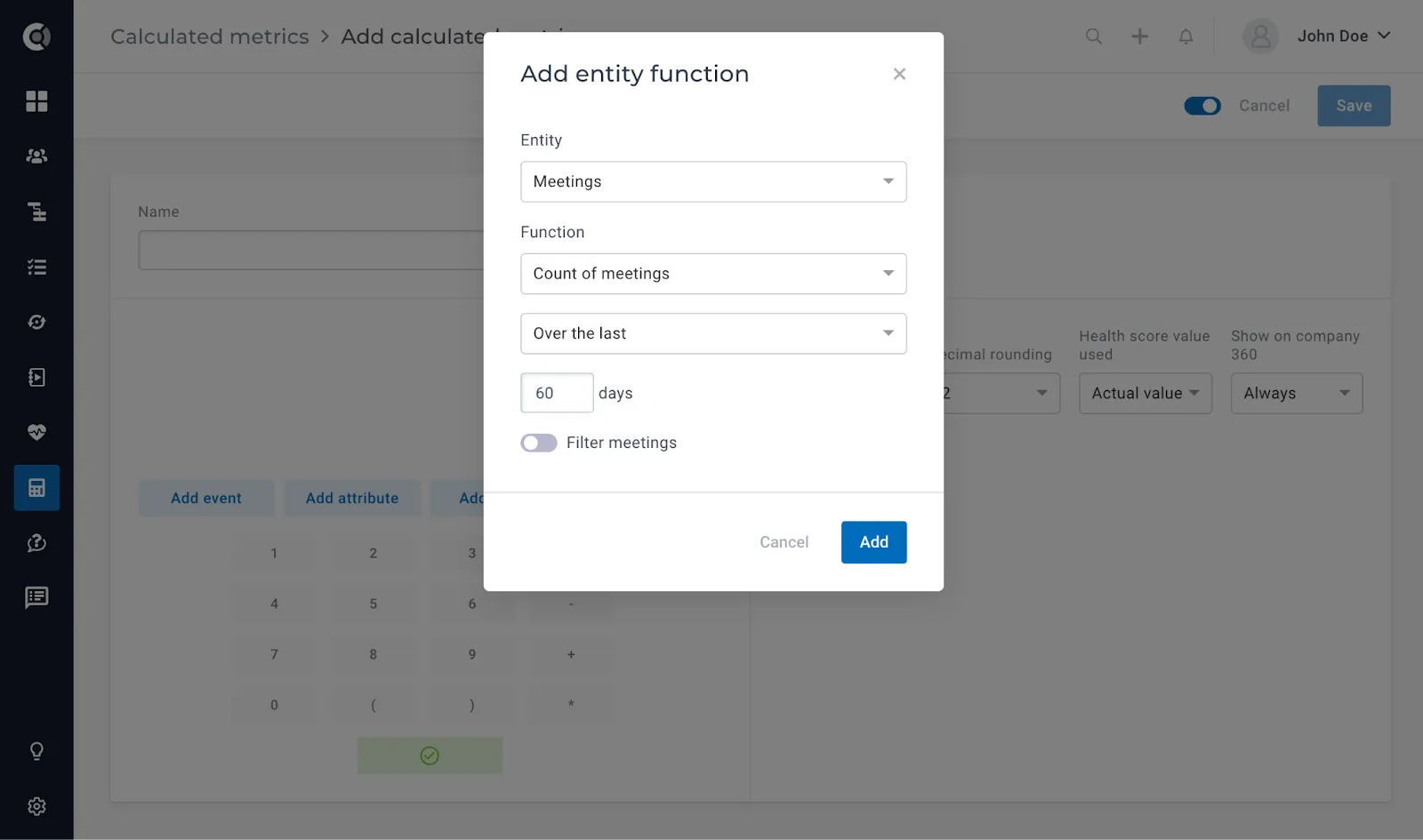
In general, if a client has no interest in interacting with your customer success team might be a bad sign and should feed into the Global Health score.
Of course, since engagement expectations might differ on the customer’s journey, you can create different health scores with different worst/best values according to the maturity of the account (e.g. during the adoption phase, the metrics should be higher than during the maturity phase).
CSM rating
The CSM rating feature allows your CSMs to give a subjective score to each account. The scoring system is totally under your control, so you can decide how should the CSMs use the feature, but as a suggestion, you can consider:
- Are they achieving their goals using your product?
- How is the relationship with the primary point of contact? Do they hold influential positions within the company? Are there multiple points of contact established? Has the champion responsible for advocating your product left the company?
- How is the adoption of the platform across the entire team? Are there any indications of lack of engagement or resistance?
- Is the customer unresponsive or uncommunicative? Are they not providing timely feedback or participating in discussions?
- During meetings, what feedback do customers share? Are they satisfied with the product? Are there any identified obstacles or challenges hindering their experience?
- Is there any additional feedback, concerns, or issues expressed by customers related to the platform or its usage?
Updating the CSM rating should be an ongoing process. You can advise the CSMs to set the initial score during/after the onboarding and then keep it updated – they can update it after each meeting, or it could be a recurrent task (e.g. every month).
You can then use the CSM rating as a health score that feeds into the Global Health Score – it will bring a subjective scale to the calculation of the general health.
Customer Satisfaction
Consider running CSAT/NPS campaigns to obtain feedback from your clients. This feedback is, in general, extremely relevant not only for the overall success of the client, but also for establishing the renewal success for that client.
Use the CSAT and the Promoter scores as health scores.
Make sure to restrict the health scores only to companies that did provide a score; otherwise, the overall health of clients might be artificially decreased.
Setting up the health scores
Once you have decided on the data points that you want to measure, the only remaining thing is to set up your health scores.
Key factors of setting up the health scores correctly:
- (For events) Make sure you consider rather larger periods of time (e.g. setting up health scores based on how many events were generated in the last day or last 7 days could create false negatives in certain periods, for example vacation times).
- Set up a reasonable “best value” – you can track the average results of the measured metric for a period of time, so you can have a starting point. Ideally, you shouldn’t have too many companies in the green area, nor in the red area – that might be an indicator that your expectations are either too low or too high.
- Decide on the weight of each health score. As mentioned before, the focus should be on the key features of your product, rather than the ones that are not as commonly used.
- Make sure to restrict the health scores to the proper segments. If you are measuring metrics that are not general across all the companies, make sure to restrict the health score to the segment of companies that have a value under that metric (e.g. CSM rating health score should be restricted only to companies that do have a CSM rating).
Observation! If a metric/attribute has no value (n/a) it will be measured as 0 within the health scores, so this might generate inaccurate results if the health score is not properly restricted to segments.
- You can monitor the health scores for a period of time and adjust them until you are comfortable that they are reflecting correctly the success of a client.
Leveraging the health scores
Once the health scores are set, here are some recommendations on how to leverage them:
- Build individual CSM dashboards to display the health of their customers. CSMs should check recurrently the unhealthy customers and decide on the next steps to re-engage them.
- Build playbooks to alert you/to create tasks etc. when the companies’ health goes below a threshold or when the trend is descending (e.g. you can create a metric to compare the current Global Health Score with the value it had X days ago – if this metric is below a certain %, trigger action items).
- Segment your customers based on health and build overall re-engagement processes (e.g. email campaigns with best practices, links to KB articles, send invitations to a call with the CSM etc.).
The Global Health Score is also a key indicator in our standard reports. You have access to information regarding the next renewals, as well as cashflow forecasting per Global Health Score.